
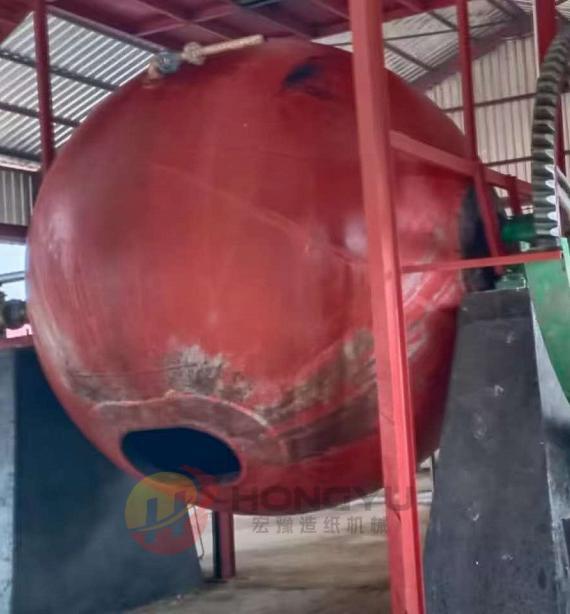
Core Structure & Working Principle
-
Key Structural Features
- Spherical shell: The signature component, a sealed, hollow spherical vessel forged from thick, high-pressure-resistant carbon steel or stainless steel. Its round shape ensures uniform heat and chemical distribution during cooking, minimizing localized overheating or incomplete reaction of raw materials, and the robust structure withstands internal pressures of 0.6–1.2 MPa and temperatures of 140–180°C.
- Drive & tilting system: Equipped with a motor-driven gear or roller mechanism that enables slow rotation (or tilting) of the digester ball. Rotation ensures full contact between raw materials and cooking liquor, while tilting allows convenient loading of raw materials from the top and unloading of cooked pulp from the bottom.
- Cooking liquor inlet & exhaust system: A dedicated pipeline to inject chemical cooking liquors (e.g., soda-anthraquinone liquor, kraft liquor) and a pressure relief valve to discharge steam and residual gases during the cooking process, ensuring operational safety.
- Sealing & safety components: A heavy-duty, airtight cover with locking clamps to maintain internal pressure, plus pressure and temperature sensors that trigger alarms or automatic shutdowns if parameters exceed safe limits, preventing equipment failure or accidents.
-
Operational Mechanism
The digester ball operates through a batch chemical cooking process based on lignin degradation:
- First, lignocellulosic raw materials (crushed into chips or bundles) and pre-configured cooking liquor are loaded into the spherical shell through the top inlet, with the fill volume controlled at 60%–70% of the ball’s total capacity to leave space for steam expansion.
- The cover is sealed, and steam or a heating jacket is used to raise the internal temperature and pressure to the preset pulping conditions. The drive system rotates the digester ball slowly (1–3 rpm) to mix the raw materials and cooking liquor thoroughly, ensuring the chemicals evenly penetrate the biomass.
- Under high-temperature and high-pressure conditions, the cooking liquor reacts with lignin and hemicellulose in the raw materials, breaking their bonds with cellulose fibers and dissolving non-fiber components into the liquor (forming black liquor in kraft pulping).
- After 2–6 hours of cooking (depending on raw material type), the pressure is relieved, the digester ball is tilted, and the cooked pulp (along with residual liquor) is discharged to downstream washing and screening processes to separate clean cellulose fibers from the spent liquor.
Key Functions & Application Scenarios in Papermaking
-
Fiber separation for chemical pulping
It is dedicated to converting plant-based raw materials into chemical pulp by removing lignin, enabling the production of pulp with high strength and purity for cultural paper, specialty paper, and high-grade packaging paper. Its adaptability allows it to process both woody (wood, bamboo) and non-woody (straw, bagasse) fibers, suiting regional raw material supply in small mills.
-
Batch pulping for flexible production
As a batch-type device, it supports small-batch, multi-variety pulping. Mills can adjust cooking parameters (time, temperature, liquor ratio) for different raw materials or pulp grades, meeting the needs of niche paper production that does not require continuous, large-scale output.
-
Cost-effective solution for small mills
Compared to large continuous digesters, the digester ball has lower initial investment, simpler installation, and easier maintenance, making it the preferred pulping equipment for small-to-medium pulp mills with limited capital and production scale, especially in regions with abundant agricultural or forestry biomass resources.
There are no reviews yet.