
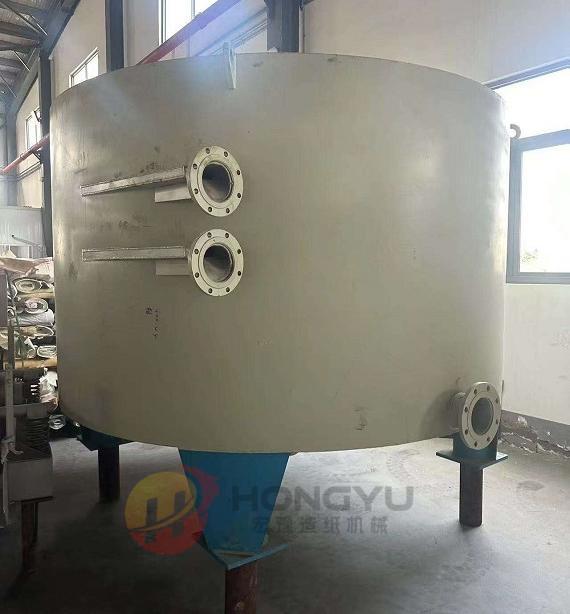
Core Structure & Working Principle
-
Key Structural Features
- Reaction & mixing zone: The front-end unit where deinking chemicals (e.g., surfactants, caustic soda, hydrogen peroxide) are mixed with waste paper pulp. It is equipped with a low-shear agitator to evenly disperse chemicals, break down ink-fiber bonds, and prevent excessive fiber damage.
- Flotation/washing separation module: The core purification component, with two mainstream designs:
- Flotation-type module: Consists of an aeration system, flotation tank, and foam scraper. The aeration system generates fine air bubbles that attach to ink particles and sticky impurities, lifting them to the pulp surface to form foam, which is then scraped off and discharged as waste.
- Washing-type module: Uses a porous screen or belt to filter pulp, with countercurrent fresh water flushing away dissolved ink and small particulate impurities, similar to the principle of a pulp washer but optimized for ink removal.
- Many modern models integrate both flotation and washing units (combined deinking machines) for multi-stage purification.
- Impurity discharge & pulp collection system: A dedicated pipeline to remove ink-laden foam or wastewater, and a concentrated pulp outlet that delivers purified recycled pulp to downstream washing or refining processes, with pulp consistency adjusted to 8%–12% for subsequent use.
- Chemical dosing control system: A precision metering device that regulates the dosage of deinking agents based on pulp type and ink content, ensuring optimal deinking efficiency while minimizing chemical waste.
-
Operational Mechanism
The deinking machine works through a combination of chemical decomposition and physical separation:
- First, waste paper pulp (after initial dissociation in a hydrapulper) is fed into the reaction zone, where deinking chemicals react with ink particles to weaken their adhesion to cellulose fibers and emulsify ink into small droplets.
- For flotation-type machines, the aeration system injects micro-bubbles into the chemically treated pulp. The hydrophobic ink particles and sticky contaminants attach to the bubbles, rising to form a stable foam layer on the pulp surface, which is continuously scraped off and sent to waste treatment.
- For washing-type machines, the pulp is spread on a filter medium, and countercurrent water washes away soluble ink components and fine ink particles that pass through the filter pores, leaving clean fibers on the medium surface.
- Combined deinking machines first use flotation to remove large ink particles and then washing to eliminate fine residual ink, achieving higher pulp purity for premium recycled paper production.
Key Functions & Application Scenarios in Papermaking
-
Ink and contaminant removal
It targets various printing residues (offset ink, toner, water-based ink) and sticky impurities (adhesives, plastic fragments from labels) in waste paper, preventing discoloration, spots, and strength defects in the final recycled paper product.
-
Recycled pulp quality optimization
By adjusting chemical dosage and separation parameters, it can produce recycled pulp of different purity levels, meeting the requirements of various paper products—from low-grade packaging paper to high-quality cultural paper and tissue paper.
-
Sustainable waste paper utilization
It enables the recycling of post-consumer and post-industrial waste paper, reducing reliance on virgin wood pulp, cutting forestry resource consumption, and lowering the environmental footprint of papermaking operations.
-
Process compatibility with recycling lines
It integrates seamlessly with upstream hydrapulpers and downstream pulp washers/refiners, forming a complete waste paper recycling pulping line, and can be customized for specific waste paper types (e.g., newsprint-dominated, cardboard-dominated pulp) to maximize deinking efficiency.
There are no reviews yet.