
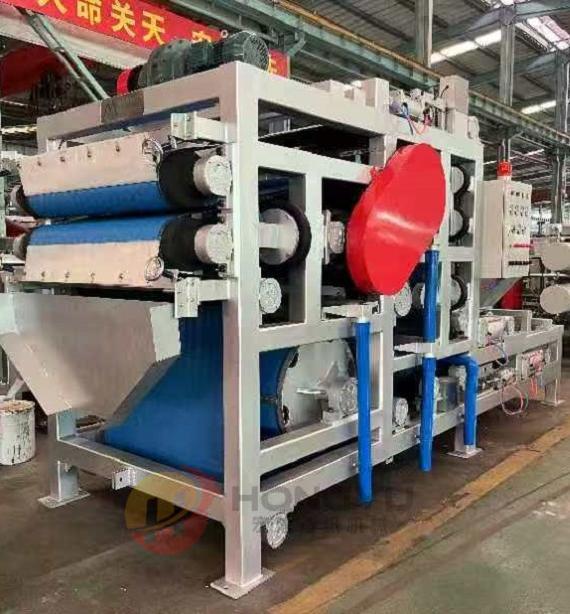
Core Structure & Working Principle
-
Basic Structure
A typical filter press consists of five key components:
- Filter plate assembly: The core separation unit, composed of multiple alternating filter plates and filter frames (or diaphragm plates for enhanced dehydration) clamped together in a row. Each plate is lined with a porous filter cloth that traps solids while allowing liquid to pass through.
- Hydraulic clamping system: A hydraulic cylinder that applies high pressure (typically 1–3 MPa) to clamp the filter plate assembly tightly, forming a series of sealed filtration chambers between adjacent plates.
- Feed pump: A high-pressure pump that injects sludge or pulp slurry into the sealed filtration chambers at a controlled flow rate.
- Filtrate collection system: A trough or pipeline network beneath the filter plates that collects the liquid (filtrate) passing through the filter cloth for recycling or wastewater treatment.
- Discharge mechanism: A mechanical or automated system that releases the clamped filter plates, allowing the solid cake (dewatered sludge or purified pulp residue) to fall into a collection chute for disposal or further processing. Diaphragm-type models also include a compressed air or water backwashing system to squeeze out residual moisture from the cake.
-
Operational Mechanism
First, the hydraulic system clamps the filter plate assembly to form sealed filtration chambers. The high-pressure feed pump then injects papermaking sludge or dilute specialty pulp into these chambers. As the slurry fills the chambers, the filter cloth acts as a barrier: liquid (wastewater or pulp filtrate) permeates the cloth and flows into the collection system, while solid particles (sludge flocs or pulp micro-impurities) are trapped inside the chambers and gradually form a thick filter cake. For diaphragm filter presses, after the initial filtration, compressed air or water is pumped into the diaphragm plates to expand them, applying secondary pressure to the filter cake and squeezing out residual moisture to achieve deeper dehydration. Once filtration is complete, the hydraulic system releases the plate assembly, and the solid cake is discharged. The filter cloth can be cleaned via backwashing for reuse in subsequent cycles.
Key Functions & Application Scenarios
- Papermaking Sludge Dewatering: Reduces the moisture content of sludge from papermaking wastewater, shrinking the volume of solid waste by 50%–70% to facilitate transportation, incineration, or landfill disposal and meet environmental discharge regulations.
- Specialty Pulp Purification: Removes micro-impurities (such as fine ash particles and resin residues) from high-grade pulp (e.g., food packaging paper pulp, filter paper pulp) to improve pulp whiteness and purity, ensuring the final paper meets strict quality standards.
- Wastewater Reclamation: The collected filtrate can be further treated and recycled as process water in pulping lines, reducing fresh water consumption and lowering the overall water footprint of the paper mill.
- Automated Batch Operation: Can be equipped with fully automated plate clamping, cake discharge, and cloth cleaning systems, enabling unmanned batch operation and reducing labor costs for large-scale paper production facilities.
There are no reviews yet.