
Core Structure & Working Principle
-
Basic Structure
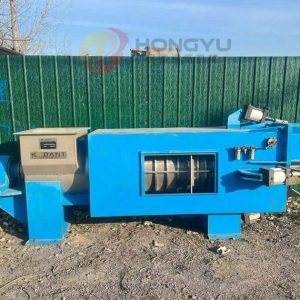
A typical twin-screw press dewaterer is composed of five core components:
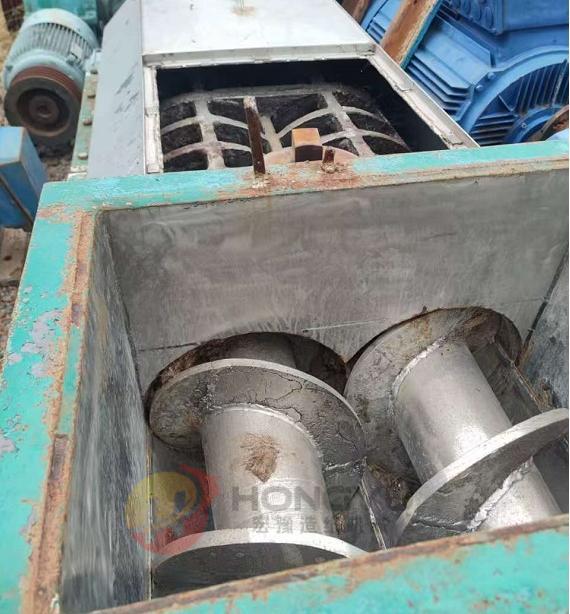
- Twin-screw rotor assembly: The core squeezing unit, consisting of two intermeshing screw shafts (divided into co-rotating and counter-rotating types) installed in a closed casing. The screw pitch gradually decreases from the feed end to the discharge end, and the screw surface is usually coated with wear-resistant materials to extend service life.
- Slotted casing/screen cylinder: A pressure-resistant housing wrapping the twin-screw rotor, with dense filter slots (0.15–0.5 mm) distributed on its wall for discharging squeezed water. The casing tapers toward the discharge end to enhance extrusion pressure.
- Feed hopper & adjustable discharge choke: A sealed hopper for feeding pre-concentrated pulp, and a pressure-adjustable choke device at the discharge port to control the internal pressure of the dewatering chamber and adjust the final pulp consistency.
- Filtrate collection system: A sealed trough outside the casing that collects the water separated from the pulp, with a pipeline for recycling the filtrate as process white water.
- Drive & control system: A dual-motor or synchronous drive system that ensures the stable rotation of the twin-screw rotor, and an intelligent control panel for adjusting rotational speed and discharge pressure according to pulp properties.
-
Operational Mechanism
Pre-concentrated pulp is fed into the feed end of the device and is jointly conveyed toward the discharge end by the rotating twin-screw rotor. As the screw pitch narrows and the casing tapers, the space for pulp continuously shrinks, and the intermeshing of the two screws generates uniform and gradual extrusion force on the pulp. Under this dual-screw synergistic compression, free water and part of the bound water in the pulp are squeezed out through the filter slots of the casing into the filtrate collection system, while the fiber structure is well-preserved due to the balanced stress. The adjustable discharge choke can fine-tune the internal pressure of the dewatering chamber (usually 0.5–2.0 MPa) to achieve the target pulp consistency (up to 45% for high-demand scenarios). The dehydrated high-consistency pulp cake is discharged from the outlet and sent to subsequent drying, refining, or papermaking processes, and the collected filtrate is recycled to reduce fresh water consumption in the pulping line.
Key Functions & Application Scenarios
- High-efficiency Deep Dewatering: Compared with single-screw models, it provides higher extrusion pressure and more uniform stress distribution, achieving 5%–10% higher pulp consistency while reducing energy consumption per unit of dehydrated pulp.
- Low Fiber Damage: The cooperative rotation of twin screws avoids local excessive shearing force, effectively preserving the length and strength of pulp fibers, which is critical for producing high-strength specialty paper (e.g., packaging paper, filter paper).
- Adaptability to Complex Pulp: Its strong anti-clogging performance makes it suitable for dewatering recycled pulp containing sticky impurities (such as waste cardboard pulp with adhesives) and pulp with high fiber entanglement, reducing equipment downtime for cleaning.
- Intelligent & Stable Operation: The synchronous drive and adjustable control system enable 24/7 continuous operation, and it can be seamlessly integrated into automated pulping lines to realize real-time adjustment of dehydration parameters according to pulp quality changes.
There are no reviews yet.