
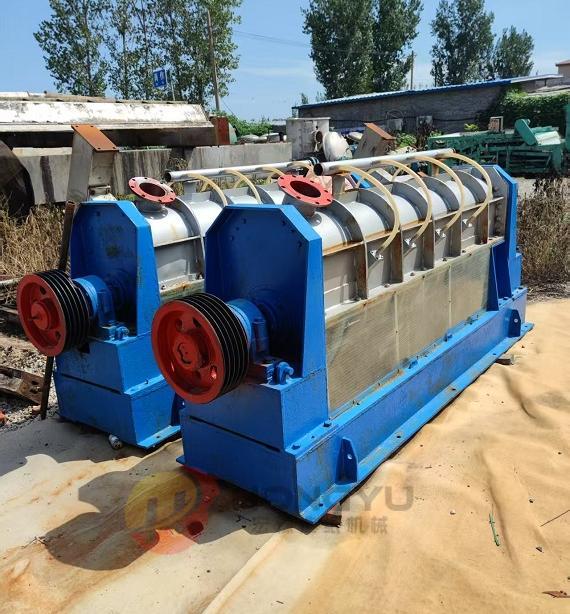
Core Structure & Working Principle
-
Key Structural Features
- Separation chamber: The core unit, typically a cylindrical or conical vessel made of wear-resistant stainless steel to withstand impact from hard impurities. It is equipped with specialized internal components (e.g., rotating impellers, slotted screens, or centrifugal cones) that vary by separation type, and the chamber is designed to create differential movement between pulp and impurities for efficient sorting.
- Impeller/drive system: For centrifugal models, a high-speed impeller generates rotational flow in the chamber, creating centrifugal force to segregate heavy impurities (e.g., sand, metal) from lighter pulp fibers. For screening-type separators, a low-speed drive powers a rotating screen drum that traps oversized contaminants while allowing qualified pulp to pass through the screen slots.
- Pulp inlet/outlet & reject discharge port: A tangential or central inlet distributes pulp evenly into the separation chamber; a bottom or side outlet delivers purified pulp to downstream processes (e.g., refiners, pulp storage tanks); a dedicated reject port (usually at the chamber bottom or top, depending on impurity type) collects separated contaminants for centralized disposal.
- Wear-resistant linings: The inner walls of the separation chamber and key components are lined with rubber or ceramic materials to reduce abrasion from hard impurities, extending the device’s service life and reducing maintenance frequency.
-
Operational Mechanism
The reject separator works through two mainstream separation principles, depending on its design:
- Centrifugal separation: When pulp enters the high-speed rotating chamber, centrifugal force pushes dense, heavy impurities (sand, metal) toward the chamber wall, where they slide down to the bottom reject port for discharge. Meanwhile, lighter cellulose fibers remain in the central pulp flow and exit through the purified pulp outlet, completing the separation of heavy slag from pulp.
- Screening separation: Pulp is forced through a rotating slotted screen drum. Qualified pulp fibers (of appropriate length and size) pass through the screen slots, while oversized contaminants (undissociated fiber bundles, plastic pieces) are retained on the drum surface and scraped off into the reject discharge system. Some models combine centrifugal and screening functions for multi-stage purification of complex impurities.
Key Functions & Application Scenarios in Papermaking
-
Impurity removal and equipment protection
It eliminates hard, abrasive impurities (sand, metal) that would otherwise wear down or damage downstream equipment like refiners, pulp pumps, and paper machine headboxes, reducing equipment downtime and maintenance costs. For recycled pulp lines, it also removes plastic and sticky contaminants that cause paper defects.
-
Pulp quality improvement
By filtering out undissociated fiber bundles and irregular debris, it ensures uniform fiber size and distribution in the pulp, preventing paper defects such as surface spots, holes, and uneven thickness, which is essential for producing high-quality cultural paper and smooth packaging paper.
-
Adaptability to different pulp systems
Available in high-consistency (8%–15%) and low-consistency (2%–5%) models, it can be integrated into various pulp processing stages—from the initial pulp dissociation stage (to remove coarse slag from raw pulp) to the final purification stage before the paper machine (to polish pulp quality).
-
Continuous and efficient processing
Designed for non-stop operation, it matches the throughput of large-scale papermaking lines, with automatic reject discharge that eliminates manual cleaning interruptions and maintains consistent pulp supply to downstream processes.
There are no reviews yet.