
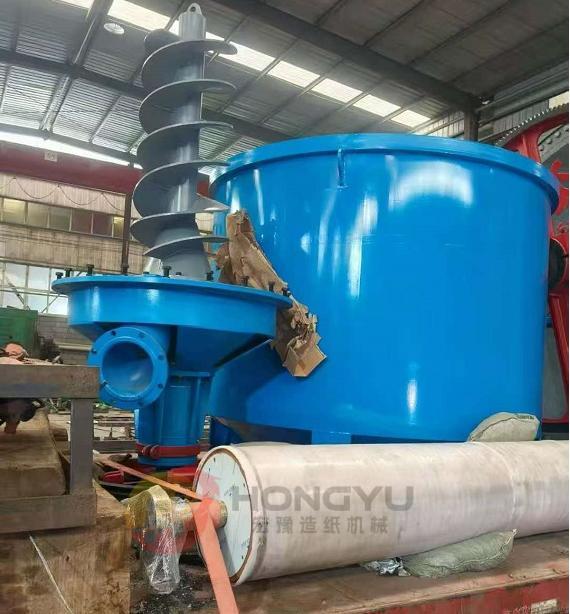
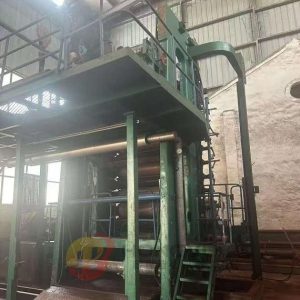
The high-consistency hydrapulper is an upgraded core pulping device for large-scale waste paper recycling lines, designed to dissociate waste paper or virgin fiber raw materials at a pulp consistency of 15%–30% (much higher than the 3%–15% of conventional hydrapulpers). It combines intense mechanical agitation and hydraulic shearing to achieve efficient fiber dissociation while minimizing impurity dispersion and fiber damage, making it a pivotal front-end equipment for high-yield recycled pulp production.
Core Structure & Working Principle
-
Basic Structure
A typical high-consistency hydrapulper has five key components, with optimized designs to adapt to high-concentration slurry:
- Reinforced tank body: A large, sealed cylindrical vessel made of thickened stainless steel or wear-resistant concrete, with a reinforced base to withstand the high viscosity and pressure of concentrated slurry. Its volume is usually 10–150 cubic meters, matching large-scale production demands.
- High-torque rotor assembly: The core working unit at the tank bottom, equipped with heavy-duty, curved blades (4–8 blades) and driven by a low-speed (30–100 RPM), high-power motor. The rotor’s special shape creates strong vertical and circular fluid flow to agitate dense slurry effectively.
- Concentration control system: A sensor and feeding module that precisely regulates the ratio of waste paper to water, maintaining the slurry consistency within the 15%–30% range. It can automatically adjust water intake if the slurry is too thick to avoid equipment overload.
- Impurity separation trap: A deepened bottom trap that collects heavy impurities (nails, stones, metal scraps) and a floating impurity baffle at the tank top that blocks lightweight contaminants (plastic films, foam) from mixing into the pulped slurry, reducing secondary dispersion of impurities in high-concentration environments.
- Discharge & dilution unit: A specialized outlet with a dilution water nozzle at the tank side. Before discharge, low-pressure water is injected to reduce the slurry consistency to 8%–12%, making it suitable for transportation to downstream screening equipment.
-
Operational Mechanism
The high-consistency hydrapulper works based on shear friction between fibers and mechanical agitation, which differs from the low-consistency model’s reliance on hydraulic vortex:
- First, waste paper raw materials (such as OCC or MOW) are fed into the tank, and a small amount of water is added to form a high-concentration slurry (15%–30%). The dense slurry reduces the floating of lightweight impurities and enhances fiber-to-fiber contact.
- When the high-torque rotor rotates, it drives the slurry to form intense local turbulence. The fibers rub and collide with each other and the rotor blades, creating strong shear forces that tear paper sheets and fiber bundles into individual fibers. The high concentration also prevents excessive fiber shortening caused by over-agitation.
- Heavy impurities sink to the deepened bottom trap and are removed periodically, while lightweight impurities are blocked by the top baffle and skimmed off manually or automatically.
- After 20–40 minutes of pulping (shorter than low-consistency models for the same output), dilution water is injected to lower the slurry consistency, and the dissociated pulp is pumped to downstream purification processes.
Key Functions & Application Scenarios
- High-efficiency Fiber Dissociation: At 15%–30% consistency, it achieves higher fiber recovery rates (over 95%) than conventional hydrapulpers, as the dense environment reduces fiber loss with wastewater.
- Low Impurity Dispersion: The high-concentration slurry limits the spread of sticky contaminants and ink particles, making it easier to remove impurities in subsequent processes and improving the cleanliness of recycled pulp.
- Energy-saving Operation: Despite its high-power motor, it consumes 10%–20% less energy per ton of pulp than low-consistency models, as the dense slurry requires less water for dilution and transportation.
- Large-scale Waste Paper Recycling: It is the preferred front-end pulping equipment for large recycled paper mills, especially those processing old corrugated containers (OCC) and mixed office waste (MOW) in batches or continuously, ensuring stable pulp output and quality.
There are no reviews yet.